Mark Testing Instruments provides industry-leading force, materials, and torque testing solutions tailored for hospitals, dental clinics, medical research facilities, and teaching institutions. Engineered to meet the exacting demands of clinical, surgical, and laboratory settings, our systems deliver accurate, repeatable, and reliable data to ensure patient safety, optimize device operation, and maintain strict regulatory compliance. Our mechanical testing instruments are utilized across a broad spectrum of medical and dental applications. They are designed to address diverse clinical and healthcare testing requirements, including: Infusion Therapy Calibration: Calibrating syringe pumps to ensure the precise and controlled delivery of medications. Dental Biomechanics: Evaluating the mechanical performance and durability of natural teeth, dental bridges, and prosthetic components under realistic loading conditions. Orthopedic Integrity: Assessing the tensile and rotational strength of bone screws, prosthetic joints, and surgical implants. Medical Device Strength: Measuring the tensile, compressive, and torsional limits of essential devices, including: Syringes and catheters Medical tubing Luer fittings and connectors Physiotherapy Assessments: Evaluating isometric muscle strength to track and assess patient recovery and rehabilitation from injuries. Advanced Testing Instrumentation The force and torque testing instrumentation from Mark Testing Instruments offers advanced programmability and precise control. Our systems can execute fully automated test routines, accurately capture complex data (such as load-versus-displacement or torque-versus-rotation), and generate comprehensive reports tailored for quality assurance, regulatory compliance, and cutting-edge research. Global Reach and Reliability Deployed in hospitals, teaching institutions, and research laboratories worldwide, Mark Testing Instruments' solutions deliver the flexibility, reliability, and cost-effectiveness that the modern healthcare industry demands. By integrating rigorous mechanical testing into daily clinical and research practices, professionals can optimize device design, ensure long-term equipment reliability, and uphold the highest possible standards of patient care and safety.

Industries
Hospitals
Instruments for this industry

Analogue HDT / VSP Apparatus – 3 Station
The MARK-HDT-VSP-3A Analogue HDT / VSP Apparatus – 3 Station from Mark Testing Instruments is a heavy-duty, multi-station lab...
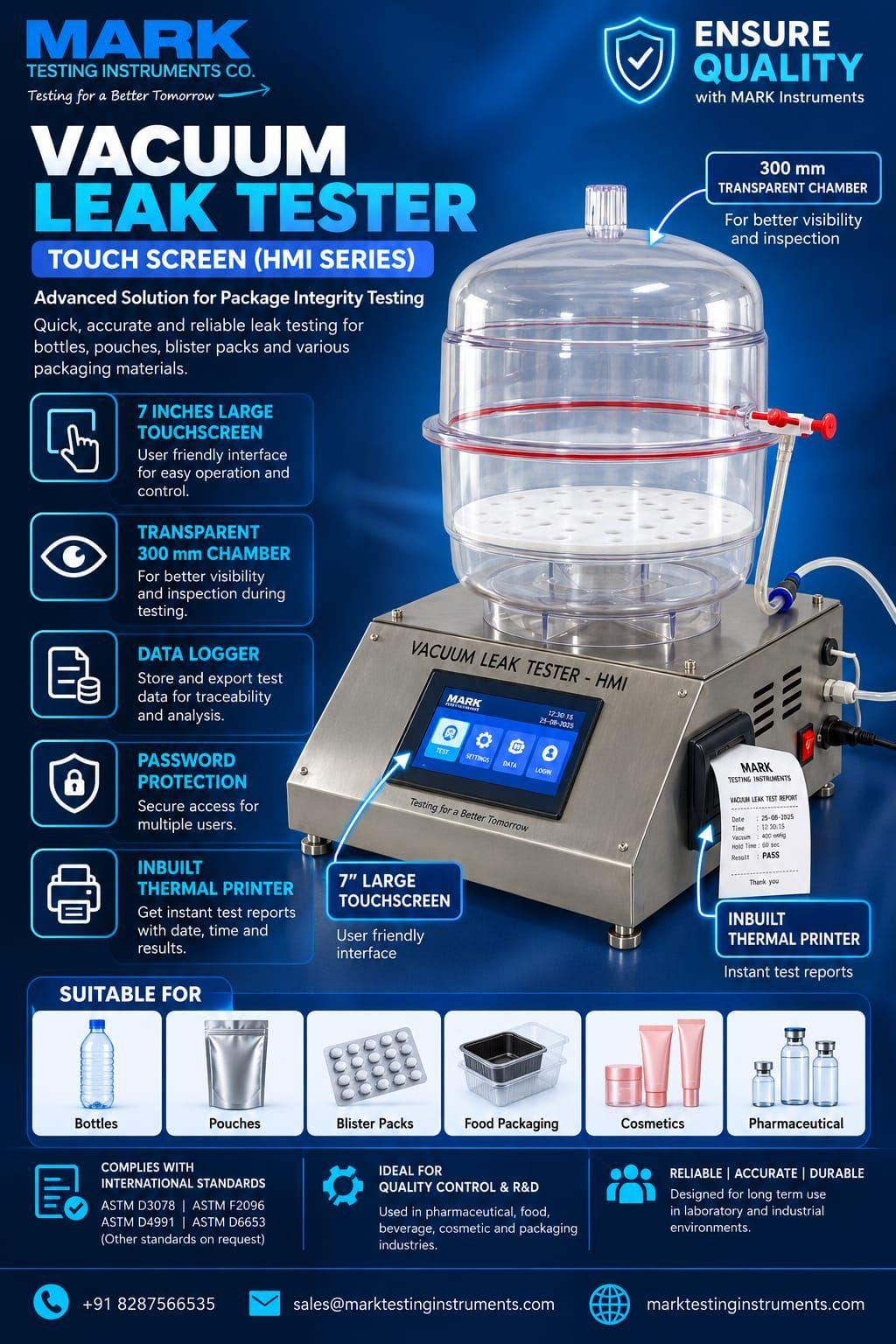
7" HMI Touchscreen Vacuum Leak Tester with Thermal Printer
The MARK-VLT-10HMI7P(Neo) 7" HMI Touchscreen Vacuum Leak Tester with Thermal Printer from Mark Testing Instruments is an adva...